GEO vs SEO vs AEO: where the line actually falls
Most of GEO is SEO. geo.new’s check catalog draws the line in code: the checks a page shares with classic search, and the short list only AI search asks for.
- Author
- Emre Elbeyoglu
- Published
- Reading time
- 9 min

Transcript
We’re going to explain GEO vs SEO vs AEO, and where the line actually falls.
Most of GEO is SEO. Google says there are no additional requirements to appear in AI Overviews.
geo.new’s catalog draws the line in code. Five families of checks no longer count. They’re not GEO-specific.
What GEO adds is a short list.
Access for AI crawlers, like OAI-SearchBot.
Main text that arrives without JavaScript. Many AI crawlers don’t run it.
Passages that stand alone. That’s where AEO lands.
And a clear entity behind the page.
Start with SEO. Then the short list.
GEO.new.
SEO gets a page found and ranked by search engines. GEO, generative engine optimization, gets it read and quoted by AI systems that write answers from several sources. AEO, answer engine optimization, began as the work of becoming the one direct answer and now often means GEO. Most of the work is shared. GEO adds a short list: AI crawler access, main text without JavaScript, passages that stand alone, and a clear entity behind the page.
GEO here is the generative kind, not geo-targeted local SEO, which shares the acronym.
Three names, three sources
SEO has the plainest definition, because Google publishes one. Its SEO Starter Guide says:
SEO—short for search engine optimization—is about helping search engines understand your content, and helping users find your site and make a decision about whether they should visit your site through a search engine.
GEO comes from a research paper. Aggarwal and co-authors, submitted in November 2023 and accepted to KDD 2024, describe generative engines as systems that "satisfy queries by synthesizing information from multiple sources and summarizing them using LLMs". They named GEO as a way to help content creators improve "their content visibility in generative engine responses".
AEO has no paper and no specification. Kalicube's page on AEO says Jason Barnard coined the term in 2017, when "Google's featured snippets and direct answers began displacing the traditional ten blue links", and defines it as "the discipline of structuring content so that answer engines retrieve, trust, and use it as the source of the direct answer to a user query." The same page says that by 2026 "its definition has fragmented". In the US results for "aeo vs geo" on 31 October 2026, several pages use AEO for winning that one direct answer and GEO for appearing in a generated one; at least one treats them as the same practice.
Side by side:
Where they overlap
For Google's own AI answers, the overlap is complete. Google's page on AI features says so directly:
The best practices for SEO remain relevant for AI features in Google Search (such as AI Overviews and AI Mode). There are no additional requirements to appear in AI Overviews or AI Mode, nor other special optimizations necessary.
The same page says a page must be "indexed and eligible to be shown in Google Search with a snippet". The checks that decide whether search can use a page decide it for AI answers too.
In geo.new's catalog, four of those checks are blockers, printed beside the score whatever the average says: ACC-01 Usable public HTML response, ACC-02 Googlebot crawl policy for the final path, ACC-10 Search indexing directives, and ACC-14 Server-rendered main content. The first three are classic SEO checks with a new prefix.
Below the blockers sits ordinary on-page work, counted in AI Access and Rendering: CORE-01 Title present, exactly one non-empty; CORE-03 Meta description present, exactly one; CORE-05 Canonical declaration; SEC-01 Final URL served over HTTPS with verified certificate; IMG-01 Alt attribute present. Content and E-E-A-T takes its four pillars from Google, whose guide to helpful content names "experience, expertise, authoritativeness, and trustworthiness, or what we call E-E-A-T". SCH-01 JSON-LD syntax would sit in any SEO audit.
Where geo.new draws the line
The catalog draws it in code. On 23 September 2026, in rules v18, five families of checks moved to tier 0, recorded as not GEO-specific. Tier 0 means a row is still measured and shown with its evidence, but it never moves the score and never reaches the fix list. That was 26 checks:
- Social, such as SOC-01
og:titleand SOC-03og:imagewith an absolute HTTP(S) URL. - URL structure, such as URL-01 Descriptive last segment and URL-08 URL length.
- Mobile: MOB-02 Intrusive fixed overlay covering the viewport and MOB-03 Horizontal-scroll risks.
- HTML validation, such as HTML-01
<!DOCTYPE html>first and HTML-02 Character encoding declared. - Internationalization, such as I18N-01
html langis a well-formed BCP 47 tag.
The catalog doesn't call these useless. It says they aren't specific to GEO, so they no longer move a GEO score.
A second change followed on 2 October 2026, in rules v22: AI Access and Rendering dropped from 25 points to 15, and Brand and Entity rose from 10 to 20. Inside AI Access and Rendering, the classic technical groups (Core, Performance, Security, Links, Images, Accessibility and Redirects, 60 counted checks between them) now share about 9.8 of the score's 100 points, and the AI access group beside them about 5.2, assuming every group has a measured check.
How the 9.8 and 5.2 are worked out
AI Access and Rendering has 15 points, split across thirteen groups whose declared weights sum to 100. Five of them, Social 4, URL structure 4, Mobile 3, HTML validation 2 and Internationalization 1, hold only tier-0 checks since rules v18, so their 14 drop out and the other eight share the 15 points by weight. The AI access group declares 30 of the remaining 86, which gives 15 × 30 / 86 ≈ 5.2. Core 15, Performance 12, Security 10, Links 6, Images 6, Accessibility 5 and Redirects 2 declare 56, which gives 15 × 56 / 86 ≈ 9.8. When a group has no measured check on a page, it drops out too and the shares move.
What GEO adds
These are what a GEO audit reads that a classic SEO audit doesn't, or weighs very differently.
Which AI crawlers may fetch the page
SEO reads robots.txt for search crawlers: ACC-02, and ACC-03 bingbot crawl policy. GEO adds the crawlers behind AI answers, which come in kinds that have to be read apart. OpenAI's crawler documentation says "Sites that are opted out of OAI-SearchBot will not be shown in ChatGPT search answers", while disallowing GPTBot "indicates a site's content should not be used in training generative AI foundation models". It adds: "Each setting is independent of the others."
geo.new reads them as three rows:
- ACC-04, AI search index crawlers (OAI-SearchBot, PerplexityBot, Claude-SearchBot, Applebot, DuckAssistBot), tier 3: "pass none disallowed · warn some disallowed · fail all disallowed".
- ACC-05, User-initiated AI fetchers (ChatGPT-User, Claude-User, Perplexity-User, Meta-ExternalFetcher, MistralAI-User), tier 1. A disallow warns, never fails.
- ACC-07, Training-only crawlers (GPTBot, ClaudeBot, CCBot and four more), tier 0: "informational, never penalized".
Main text that arrives without JavaScript
ACC-14 Server-rendered main content is a blocker for both, but the gap is wider for AI. Vercel's study of AI crawlers, published 17 December 2024, found that Gemini uses Googlebot's infrastructure and renders JavaScript, and that otherwise "none of the major AI crawlers currently render JavaScript." Since rules v23 a probable client-rendered shell fails ACC-14, because that empty page is what those crawlers receive.
Passages an answer can lift
A generative engine, in the paper's words, synthesizes "information from multiple sources". What it takes from your page is a passage, so a passage has to make sense on its own. AI Citability measures that, and at 22 of 100 points it ties Content and E-E-A-T as the heaviest category:
- CIT-02, Sections an AI answer could quote, tier 3. Every block is scored on answer, self-containment, structure, statistics and uniqueness, then averaged: "pass ≥ 60 · warn 40–59 · fail < 40".
- CIT-04, Answer-first opening under the main heading, tier 2: "pass definition or declarative answer in the first 60 words after H1 · warn absent".
- CIT-14, Answer specificity, tier 2: the share of sentences that carry a number, a figure or a named entity.
Who the page says it is
Brand and Entity has two halves. Identity is what the page declares: ENT-01 Entity identity declared, tier 2, read from an Organization or Person node, og:site_name or a visible legal name, alongside SCH-07 sameAs on the entity node in Schema and Structured Data. Reputation is what others say about the domain, and its only scored row is ENT-08 Moz Domain Authority, tier 3. It measures how strongly established sites link to the domain, a number straight out of SEO's toolbox, so even the most GEO-sounding category leans on SEO.
Files for agents
Thirteen agent observations, A01 to A13, record what an AI agent would find besides the page: A03 Markdown negotiation, A07 MCP server card and A12 llms.txt among them. They are reported, never scored.
llms.txt is a proposal by Jeremy Howard "to provide information to help agents use a website", and Google's page on AI features says "You don't need to create new machine readable files, AI text files, or markup to appear in these features." geo.new still scores the file's quality in one row, ACC-20 llms.txt quality, tier 2 since rules v18: it passes at five or more non-empty lines with at least one link, and a page with no readable llms.txt fails it.
Where AEO lands
The catalog has no AEO category, and the practices that serve a direct answer are already rows:
- CIT-04 Answer-first opening under the main heading.
- CIT-05 Question-form headings, tier 1.
- SCH-17 FAQPage markup where FAQ content exists, tier 1.
- ACC-11 Snippet and preview availability, tier 2. A
nosnippetormax-snippet:0fails it, and Google uses the same snippet controls for AI Overviews; the nosnippet guide covers how.
In geo.new's terms, AEO is a slice of citability with a snippet check attached. If someone asks you for AEO, ask which meaning they have in mind. Winning the featured snippet is the old one; appearing in generated answers is GEO.
Which one you need
Not a winner, an order. Each step assumes the one before it:
flowchart TB
  A("Googlebot can index it?") -- "No" --> S["SEO: ACC-02, ACC-10"]
  A -- "Yes" --> B("AI crawlers allowed?")
  B -- "No" --> R["robots.txt: ACC-04"]
  B -- "Yes" --> C("Text in source HTML?")
  C -- "No" --> H["Server-render: ACC-14"]
C -- "Yes" --> D["Passages, entity: CIT, ENT"]- The page isn't indexed, or Googlebot can't fetch it. SEO, and Google's AI answers can't use the page either. ACC-02 and ACC-10 show why.
- It ranks, but robots.txt shuts out AI search crawlers. GEO only. ACC-04 lists each crawler; training crawlers are a separate choice.
- The main text appears only after JavaScript runs. Both. Google renders it; most AI crawlers outside Google receive an empty page.
- The answers are there, in long, tangled passages. GEO and AEO. CIT-02 names the weakest section and what costs it most.
- Nobody can tell who publishes it. Both. ENT-01 and SCH-07 read what the page declares about itself.
How geo.new reads each
Every row above is in the check catalog with its tier and group. Under rules v23, we sort the six categories this way:
- Mostly shared with SEO: Content and E-E-A-T (22), Schema and Structured Data (13), and the classic technical groups of AI Access and Rendering (about 9.8 of its 15).
- Specific to GEO: AI Citability (22) and the AI access group (about 5.2).
- Both at once: Brand and Entity (20), whose declarations search reads too and whose reputation half is Moz Domain Authority, and Platform Readiness (8), which counts rows from both sides again for each of five AI platforms.
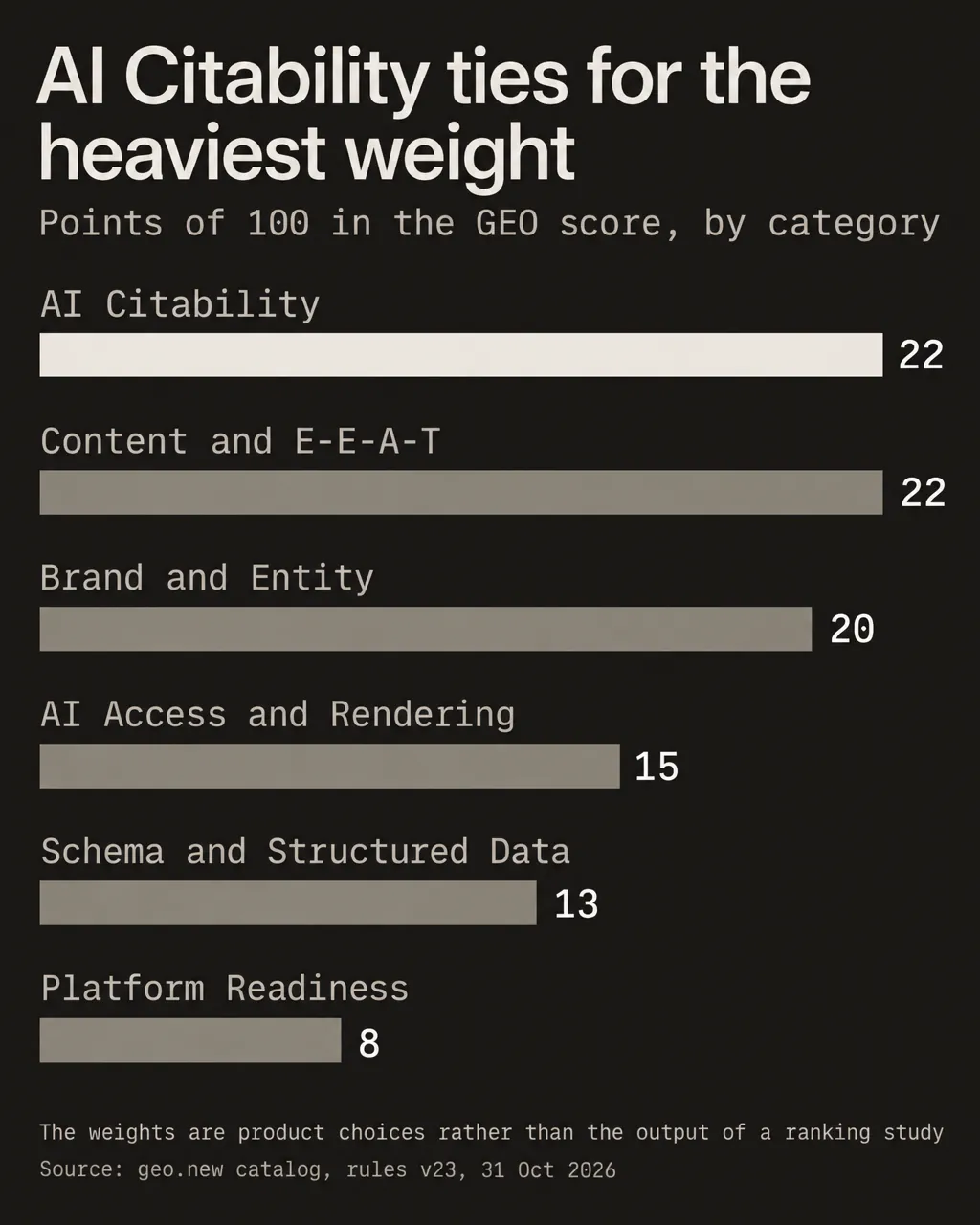
That sorting is ours, not an industry standard, and the weights are product choices rather than the output of a ranking study. A pass means a signal was present, not that any assistant cited the page.
Method and limits
- Sources
- Google’s SEO Starter Guide, its page on AI features and its guide to helpful content; OpenAI’s crawler documentation; Aggarwal et al., “GEO: Generative Engine Optimization” (arXiv 2311.09735, KDD 2024); Kalicube’s page on Answer Engine Optimization; Vercel’s December 2024 study of AI crawlers; the llms.txt proposal. All read on 31 October 2026, with the US search results for “aeo vs geo” from DataForSEO the same day.
- Checks
- 176 checks under rules v23, as of 31 October 2026: 124 scored and 52 tier 0. Tiers and weights are read from the catalog’s code; the five families moved to tier 0 in rules v18 (23 September 2026) and the category weights changed in rules v22 (2 October 2026).
- Limits
- Sorting the categories into shared and GEO-specific is geo.new’s reading of its own catalog, not an industry standard. The point shares assume each group has a measured check. A pass means a signal was present, not that any assistant cited the page.
founder · geo.new
Founder of several B2B SaaS products, and fifteen years of work in SEO and growth.